


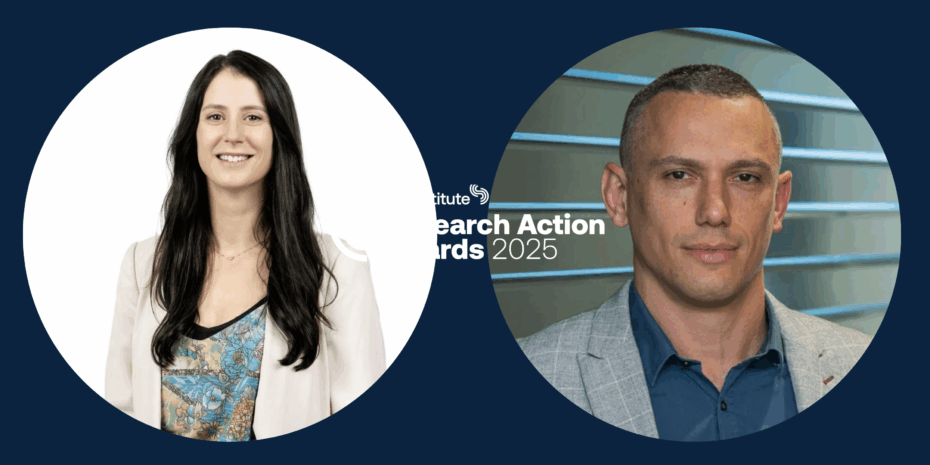
Outstanding Australian researchers have been recognised for their contributions to strengthening health policy and improving health services, each receiving a 2025 Sax Institute Research Action Award.
Associate Professor Gustavo Machado, from the University of Sydney, received his Award for pioneering work to improve back pain care and reduce the unnecessary use of opioid medicines – a significant contributor to avoidable harm in Australia.
Adjunct Associate Professor Katinka van de Ven, from alcohol and other drug consultancy 360Edge, received her Award for leading culturally grounded, capacity-building research that is transforming alcohol and other drug services, particularly in Aboriginal and Torres Strait Islander community settings.
Both outstanding researchers were selected for their commitment to solving complex health challenges through evidence that has translated directly into better policy, safer care and improved outcomes for communities.
Tackling Australia’s escalating back pain and opioid crisis
Back pain affects one in six Australians and is the leading contributor to disability nationwide. It costs the health system $3.4 billion each year in direct care and a further $14.8 billion in lost productivity. A major driver of this burden is the gap between evidence-based clinical guidelines and the care patients typically receive – particularly the overuse of high-risk opioid medicines.
Associate Professor Gustavo Machado has spent the past five years working to close this gap. Australia is the sixth-highest consumer of opioids globally, with 13.3 million prescriptions dispensed annually – nearly half of them for back pain. His research has revealed the scale of the problem in emergency departments, where three in four patients with back pain receive an opioid as their first exposure to these medicines. This often triggers a cascade that can lead to long-term use, dependence and in some cases addiction or overdose.
“Back pain is one of the nation’s most significant health burdens, yet clinical practice has not always reflected the evidence. This Award recognises the collective effort to close that gap – to support clinicians with better tools, encourage safer prescribing, and ensure patients receive care that genuinely improves their recovery”, say Associate Professor Machado.
To address this, Associate Professor Machado led implementation of Australia’s first evidence-based model of care for back pain, released by the Agency for Clinical Innovation. A key recommendation is a cautious approach to opioids and complex medicines, instead supporting simple analgesics and non-pharmacological strategies such as superficial heat therapy.
He spearheaded the landmark SHaPED trial, which included 4,625 patients with back pain and 269 emergency department clinicians across metropolitan and rural hospitals. Using a stepped-wedge design and implementation science methods, the program delivered clinician education, patient resources and real-time prescribing audits – helping shift practice away from opioids toward safer, evidence-based care.
His work has already influenced national guidelines, informed policy, and sparked new programs aimed at reducing avoidable harm and improving patient recovery.
Strengthening culturally informed alcohol and other drug services
Adjunct Associate Professor Katinka van de Ven was recognised for her significant contribution to building culturally grounded models of care for Aboriginal and Torres Strait Islander alcohol and other drug services.
Over the past five years, Adjunct Associate Professor van de Ven has partnered closely with Pinangba, an Aboriginal residential rehabilitation service in North Queensland, working alongside staff, families and communities to strengthen service capacity, evaluation systems and care pathways.
Her research program began with the Capacity Building for Outcome Evaluations project (commissioned by the Queensland Mental Health Commission), which established a culturally appropriate monitoring system and trained Pinangba staff to collect and use data to guide service improvement. This work embedded evaluation capability within the organisation, ensuring that outcomes could be tracked and monitored over time.
Building on the findings, van de Ven secured further funding to lead the development of Pinangba’s family-centred model of care, a codified framework designed to reflect community needs, accommodate whole-family involvement and embed culturally grounded approaches to recovery.
She has since expanded the work to address gaps in aftercare, securing Queensland Government support for a community relapse prevention program delivered both in-person and online. This initiative extends care to Aboriginal and Torres Strait Islander peoples in rural Queensland, supporting long-term recovery and reducing the risk of relapse after leaving residential treatment.
“Our goal has been to build strong, sustainable services — not just for today, but for the future. By co-designing models of care with Aboriginal leaders and strengthening workforce capability, we’re creating change that lasts. I’m proud of what we’ve achieved together and grateful for this recognition”, says Dr van de Ven.
Her leadership emphasises co-design, workforce development and sustainable improvements that continue beyond individual projects.
Celebrating research that drives real-world change
Sax Institute CEO Dr Martin McNamara said both award recipients exemplify the power of research that is designed for impact.
“These Awards honour research that doesn’t just generate new knowledge, but genuinely strengthens our health system. Gustavo and Katinka have shown how evidence, when translated well, can change policy, improve services and ultimately make a meaningful difference in people’s lives. Their work is exactly what the Research Action Awards were created to celebrate”, says Dr McNamara.
The Research Action Awards, now in their eleventh year, recognise Australian researchers whose work has made a tangible difference to health policy and practice. Previous awardees have influenced national policies, reshaped programs and supported evidence-informed decision-making across the health sector.
The 2025 Research Action Award recipients were selected by a committee of national and international experts in public health research. The Sax Institute extends its sincere thanks to the selection committee, chaired this year by Dr Michael Gluck, Vice President at AcademyHealth (United States), and committee members Professor Kathryn Oliver (London School of Hygiene and Tropical Medicine) and Professor Moira Clay (Harry Perkins Institute of Medical Research), for their expertise and rigorous assessment of this year’s nominations.
A full list of past recipients is available at saxinstitute.org.au/research-action-awards/
PUBLICATION DATE
17 December 2025
