


Two researchers whose inspiring work has had a direct impact on public health policy and practice were recognised at the Sax Institute’s 2024 Research Action Awards this month.
An animated audience of around 100 senior policy makers, research leaders and academics gathered at the NSW Parliament House in Sydney’s Macquarie Street to celebrate the achievements of the two winning researchers:
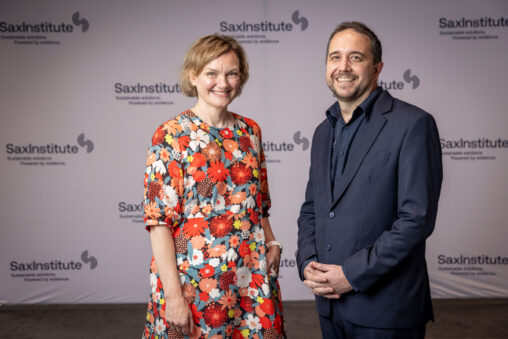
- Professor Becky Freeman, Sydney School of Public Health, University of Sydney, for her work on vape use behaviours in young people
- Professor James Smith, Rural and Remote Health Northern Territory, Flinders University, for his work on alcohol harm minimisation.
You can read more about their outstanding work here.
Established in 2015, the annual Research Action Awards celebrated their tenth anniversary this year. The Awards recognise researchers whose work has made a significant impact on health policy, programs or service delivery.
Master of Ceremonies this year was the renowned journalist, author and theologian Professor Stan Grant. A proud Wiradjuri, Kamilaroi and Dharrawal man, Professor Grant holds the Vice-Chancellor’s Chair of Australian-Indigenous Belonging at Charles Sturt University. In his welcoming comments he spoke of how the development of Aboriginal health and its incorporation of Aboriginal knowledge systems has been a revolution in his lifetime.
“Culture is part of health,” he commented. “One of the first things we’re asked for when we go to the doctor is our medical history. What about your medical history when it runs 80,000 years deep? When it incorporates 200 years of colonisation? When far too many of our people die 10 or 15 years younger than the rest of the population?”
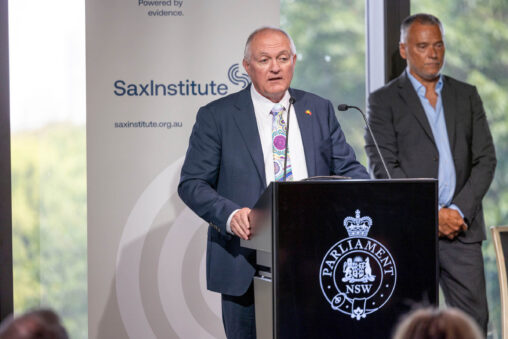
Delivering the keynote address at the ceremony, the Hon. David Harris MP – NSW Minister for Aboriginal Affairs and Treaty, Gaming and Racing, Veterans, Medical Research, and the Central Coast – spoke of the successes and priorities of the Sax Institute and the importance of its Aboriginal Health Division.
“NSW Health has a longstanding relationship with the Sax institute and I’m proud of all that has been achieved through this partnership,” he said.
“This includes your contribution to the Federal Government’s landmark decision to fund the national lung cancer screening program. Thanks to data from the long-running 45 and Up Study, you have proved the cost-effectiveness of screening for the fifth most commonly diagnosed cancer in Australia.”
The year’s ceremony also included a lively panel discussion chaired by Stan Grant on the theme of “The evolution of First Nations research: Towards self-determination of our knowledge systems”. The panel comprised Associate Professor Julieann Coombes, Senior Research Fellow at the George Institute for Global Health; Associate Professor Summer May Finlay, Senior Lecturer at the University of Wollongong; and Dr Scott Winch, Head of Aboriginal Health at the Sax Institute.
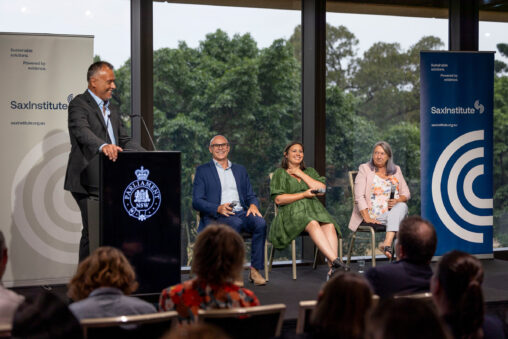
During the discussion, all three panel members stressed the importance of Aboriginal health research being done by and for Aboriginal people using Aboriginal methodologies.
“We’re only three percent of the population so of course we need to work with non-Aboriginal people, but it has to be on our own terms,” said Associate Professor Finlay.
“That means not just including Aboriginal and Torres Strait Islander people as key experts in the space but having them actually lead the research. If non-Indigenous people are genuinely interested in being allies of Aboriginal and Torres Strait Islander people, they should put our needs first. We are at a place now where we can be self-determining, with the support of our allies as the backstage crew.”
Dr Winch spoke passionately about the need for data sovereignty and the importance of returning data to communities. He also spoke about the need for research that properly aligns with Indigenous values systems.
“A lot of the measures of Closing the Gap are very deficit-focused and don’t necessarily align with our value system. I believe we need to ensure that the knowledges that are created are based on what Aboriginal people value – values such as kindness and respect and an understanding that we’re all part of an ecosystem and we’re all connected.”
In closing remarks, Sax Institute CEO Dr Martin McNamara thanked the panel members for their thought-provoking discussion and powerful ideas around data sovereignty, ethics and methodology and about how to build trust and relationships.
“Throughout our history in working in the field of Aboriginal health, the Sax Institute has focused on building partnerships with Aboriginal-led organisations with the aim of putting Aboriginal and Torres Strait Islander people at the centre of decision making around research priorities,” he said.
PUBLICATION DATE
18 December 2024
